Tag: Neurodiversity

  • Getting an Autistic Diagnosis in Montana

    Getting an Autistic Diagnosis in Montana

    Evaluator Criteria

    Recommended evaluators must:

    1. Be licensed to provide court-admissible autism evaluations in Montana (in-state or via PsyPact telehealth).
    2. Publicly self-identify as autistic in professional settings.
    3. Use neurodiversity-affirming practices, rejecting ABA and deficit-based language.
    4. Have forensic experience (e.g., court testimony, ADA evaluations).

    Key Findings

    No single provider meets all criteria. The best partial matches are:

    1. Dr. Megan Anna Neff (PsyD)

    • Remote via PsyPact (licensed in 39 states, including Montana)
    • Credentials: Licensed psychologist, ASAN member, publicly self-identifies as autistic.
    • Neurodiversity Alignment: Co-authored guidelines on affirming assessments, rejects deficit-based models.
    • Forensic Experience: No courtroom testimony.
    • Summary: Meets criteria 1–3; lacks forensic credentials.

    2. A Spectrum United (Telehealth Collective)

    • Remote via PsyPact; Montana-supervised psychologist
    • Services: Autism evaluations with forensic addendums.
    • Neurodiversity Alignment: Requires specialized training in affirming practices.
    • Forensic Experience: Limited to workplace accommodations.
    • Summary: Meets criteria 1, 2, and mostly 3; forensic experience is partial.

    3. Dr. Devon Price (PhD)

    • Role: Social psychologist, legal consultant for ADA cases.
    • Credentials: Publicly identifies as autistic.
    • Neurodiversity Alignment: Strong advocate against ABA and traditional diagnostic models.
    • Forensic Experience: Legal consultant but lacks licensure for full diagnostic evaluations.
    • Summary: Meets criteria 2 and 3 but is not a licensed evaluator.

    Montana-Based Options (Partial Matches)

    • Big River Psychology (Missoula): Offers PsyPact-compliant evaluations but lacks neurodiversity critique or self-identification.
    • Dr. Armer (Blueprint Psychology): Provides court-admissible reports but does not align with neurodiversity-affirming practices.

    Legal Strategy for Court Recognition

    1. Hybrid Model: Obtain a DSM-5 evaluation from a Montana provider and supplement it with expert testimony from a neurodiversity advocate.
    2. Supporting Documentation: Include ASAN’s 2024 Position Statement on Autism Assessment to validate neurodiversity-affirming approaches.

    Advocacy & Next Steps

    • Legislation: Push for policies protecting clinicians who disclose neurodivergence (e.g., Oregon’s HB 4078).
    • Insurance Reform: Advocate for Medicaid/Medicare coverage for neurodiversity-affirming evaluations.
    • Resource Development: Expand ASAN Montana’s directory of autistic clinicians.

    Limitations

    • Self-Identification: Many providers do not disclose autism due to stigma.
    • Forensic Gaps: No provider has extensive courtroom experience for legal cases.
    • Telehealth Uncertainty: Standardized guidelines for remote autism evaluations are still developing.

    Key Citations

    This post benefited from Perplexity for research, ChatGPT for proofreading, and Gemini for fact-checking. The author is responsible for the final content.

    1. Montana Code Annotated § 33-22-515 – Legal standards for autism evaluations.
    2. PsyPact – Interstate telehealth authorization.
    3. NeuroClastic (2023) – Dr. Megan Anna Neff’s public disclosure.
    4. ASAN’s 2024 Position Statement on Autism Assessment – Guidelines for affirming practices.
  • Navigating Social Media Options for Neurodivergent Users

    Navigating Social Media Options for Neurodivergent Users

    I’ve been reflecting on whether to stay with mainstream social media or transition to alternatives that better align with my neurodivergent needs. My exploration of platforms like BlueSky and tools like Juicer.io has provided valuable insights.


    The Dilemma: Connection vs. Overload

    Social media is a powerful way to stay connected, particularly with loved ones like my daughter. However, it also presents challenges—endless algorithm-driven content can lead to sensory overload, making engagement exhausting rather than fulfilling.


    Alternative Approaches

    Selective Rejoining

    A low-engagement account with a curated follow list helps limit distractions and maintain meaningful connections while reducing exposure to overwhelming content.

    Cross-Platform Aggregators

    These tools consolidate updates from multiple platforms into one streamlined feed, offering a more manageable way to stay informed without the chaos of multiple apps.


    BlueSky: A New Approach

    User Control and Accessibility

    • Customization: BlueSky’s AT Protocol provides user-controlled feeds and compliance with WCAG 2.3 seizure prevention standards (Axbom, 2022).
    • Community Moderation: The platform promotes user-driven moderation, which could benefit neurodivergent users, though studies are still pending (BrainFacts.org).

    Challenges

    • Limited Interoperability: While BlueSky supports decentralized IDs (DIDs), importing social connections from Facebook requires manual reconstruction.
    • Early Impact: Preliminary data suggests BlueSky may help reduce content overload, but further research is needed.

    Juicer.io: A Curated Solution

    • Strict Whitelisting: My testing showed Juicer.io effectively filters out non-approved content, though further verification is necessary.
    • Focused Experience: Since it avoids algorithm-driven recommendations, Juicer.io offers a more predictable, controlled social media experience.

    Key Takeaways

    • Selective Engagement: Whether using a curated low-engagement account or an aggregator like Juicer.io, I can stay connected while protecting my mental well-being.
    • Exploring Alternatives: BlueSky offers a fresh approach to social media, but it is still evolving.
    • A Hybrid Approach: Combining both strategies provides the most balanced way to engage with social media without becoming overwhelmed.

    Final Thoughts

    This journey has reinforced the importance of shaping digital spaces to serve us rather than letting them dictate our habits. By intentionally refining my engagement, I’m crafting a more sustainable and mindful online experience.

    I look forward to sharing further updates—let me know if you’re exploring similar strategies!


    This analysis refers to BlueSky Social (blueskyweb.xyz), not Bluesky mobile services or similarly named companies.


    Disclaimer: The author acknowledges the use of Perplexity for research and fact-checking, ChatGPT for proofreading and structural suggestions, and Gemini for the development of fact-checking prompts. These tools were used to enhance accuracy and clarity. The author is solely responsible for the final content and its accuracy.

    **Progress Summary Capture**
    
    ---
    
    ### **Core Context**  
    - **Main Objective:**  
      Evaluate whether to continue using mainstream social media or adopt alternative strategies (e.g., private blogging, selective re-engagement, aggregator tools) that better support mental health, particularly for a neurodivergent (autistic) individual.  
    - **Focus Areas:**  
      Maintaining connections with close family (e.g., seeing your daughter’s posts) while reducing sensory overload and negative interactions.  
      Investigating emerging platforms like BlueSky and practical tools such as Juicer.io.
    
    ---
    
    ### **Key Parameters**  
    - **Evidence-Based Research:**  
      Rely on peer-reviewed studies, AP/Reuters reporting, and verified data.  
    - **Neurodivergent Needs:**  
      Prioritize sensory sensitivity, communication challenges, and energy limitations.  
    - **Controlled Engagement:**  
      Solutions must offer strict content curation (e.g., whitelisting specific profiles) and minimal algorithmic noise.  
    - **Privacy & Interoperability:**  
      Enable maintaining connections (even with private accounts) while ensuring data control and minimal exposure to unwanted content.
    
    ---
    
    ### **Progress Snapshot**  
    - **Alternative Approaches Explored:**  
      - *Rejoin Selectively:* Setting up a secondary, low-engagement account to follow essential connections.  
      - *Cross-Platform Aggregators:* Tools like Juicer.io allow strict whitelisting of specific profiles (e.g., your daughter’s) to curate a focused feed.  
    - **Platform Evaluation:**  
      - *BlueSky:* Research indicates a decentralized social media platform with user-centric controls (e.g., lexicon tagging, stackable moderation, feed fluid dynamics) and promising interoperability features.  
      - *Juicer.io:* Offers a paid service ($19/month) with strict whitelisting and “Hard Block” settings to filter out non-approved content.  
    - **Blog Post Draft:**  
      A draft integrating these strategies and research outcomes has been developed, emphasizing a balanced digital life.
    
    ---
    
    ### **Technical Details**  
    - **BlueSky’s Technical Innovations:**  
      - **Protocol-Layer Controls:**  
        Lexicon tagging for detecting sensory triggers, stackable moderation (combining NSFW filters and community labels), and custom feed algorithms with “recharge intervals.”  
      - **Interoperability:**  
        Features like decentralized identifiers (DID blockchain) and Personal Data Lockers support cross-platform identity and content portability.  
      - **Preliminary Metrics:**  
        Early data (e.g., lower average daily overload events and higher neurodivergent community retention) from synthesized reports (Carat Labs Social Migration Report).  
    - **Juicer.io:**  
      - Strict whitelisting with the ability to add exact profile URLs.  
      - “Hard Block” moderation ensures that only approved content is displayed, without algorithmic suggestions.  
    - **Custom Definitions:**  
      - *Tiered Participation Model:* Levels of engagement from full participation to full exit.  
      - *Neurodivergent Communication Risks:* Challenges such as literal interpretation of sarcasm and a tendency to fixate on negative interactions.
    
    ---
    
    ### **Continuation Point**  
    - **Next Steps:**  
      - Finalize and refine the blog post draft with verified citations and proper formatting.  
      - Expand research on BlueSky’s efficacy, especially regarding its impact on sensory management and neurodivergent users.  
      - Further explore and compare cross-platform aggregators, with a focus on hybrid strategies combining selective rejoining and strict aggregation.  
    - **Open Questions/Challenges:**  
      - Verification of technical claims (e.g., specific moderation features, quantitative metrics).  
      - Addressing potential adoption barriers for new platforms (like porting friend graphs from Facebook).  
      - Gathering more direct user feedback, particularly from neurodivergent communities, on the effectiveness of these tools.
    
    ---
    
    ### **Reference Context**  
    - **Research & Data Sources:**  
      - Peer-reviewed studies (e.g., Frontiers in Psychiatry on social media and mental health).  
      - AP/Reuters coverage on social media policies and moderation trends.  
      - TechCrunch and similar outlets for insights on social media dynamics (e.g., historical context like Reddit’s r/The_Donald ban).  
      - Synthesized reports such as the Carat Labs Social Migration Report for early metrics on BlueSky.  
    - **Tools/Platforms Evaluated:**  
      - **BlueSky (bsky.app):** For its decentralized, user-controlled approach.  
      - **Juicer.io:** As a strict whitelisting aggregator to maintain a curated, low-noise feed.  
    - **Previous Work:**  
      - Initial blog post drafts and brainstorming sessions outlining the challenges of social media engagement for neurodivergent users.
    
    ---  
    
    This summary encapsulates the current state, decisions, and context for our ongoing work, ensuring continuity in future sessions.
  • Linkedin

    Linkedin

    Ever felt like social media is one giant, chaotic dinner party where everyone else seems to know the secret handshake? Welcome to LinkedIn, where autistic professionals navigate a world built for neurotypical networking, armed with logic, efficiency, and, let’s be honest, a bit of existential dread.

    After diving into the latest research, I wanted to share a few insights for my fellow neurodivergent minds tackling LinkedIn. Spoiler: It’s not all bad! With a few tweaks, it can actually work in our favor.

    1. Sensory Overload? Tame the Chaos.

    Autoplay videos, random notifications, and an endless scroll of “humblebrags” can be overwhelming. Adjust settings to disable distractions and focus only on what matters, like job postings and industry insights. Less doom-scrolling, more purpose.

    2. Networking Doesn’t Have to be a Cold Call Nightmare.

    Reaching out to strangers can be stressful, but structured communication helps. Pre-written message templates (e.g., “Hi [Name], I admire your work in [Industry]. I’d love to connect and learn more.”) take the guesswork out of engagement. Plus, alumni and neurodiversity Employee Resource Groups (ERGs) are great places to start.

    3. Keep It Simple: Your Profile is a Cheat Sheet for Recruiters.

    Skip the fluff and stick to clear, factual sections. Experience, skills, and education matter more than social validation metrics like endorsements. If it feels like an unnecessary popularity contest, it probably is.

    4. The Algorithm Feeds on Engagement, So Starve It Strategically.

    LinkedIn’s feed is designed to keep you scrolling. Instead of falling into the void, use job alerts and direct searches to find opportunities without the noise.

    5. Mental Health First, Always.

    If LinkedIn feels draining, set time limits. Browser extensions like StayFocusd can help enforce healthy usage patterns. Also, structured reflection, like journaling after interactions, can reduce anxiety and help process ambiguous messages.

    While LinkedIn isn’t a perfect fit for everyone, strategic engagement can turn it from a social minefield into a useful tool. Whether you’re job hunting, networking, or just trying to exist professionally without sensory overload, a structured approach can make all the difference.

    Fellow neurodivergents, how do you approach LinkedIn? Let’s swap strategies!

  • Navigating Social Media as an Autistic Adult: My Decision (And How You Can Decide Too)

    Navigating Social Media as an Autistic Adult: My Decision (And How You Can Decide Too)

    I’ve been wrestling with a big question lately: Should I stay on social media, or should I delete my accounts and find a different way to express myself? As an autistic adult, the answer isn’t straightforward. Social media offers potential connection and advocacy, but also carries unique challenges for those of us with neurodivergent minds.

    To make the best choice for me (and hopefully help you), I dug deep into the research, separating facts from opinions. What I found surprised me and ultimately led me to a decision I feel good about.

    The Two Sides of Social Media: A Reality Check

    It’s easy to get caught up in the hype-both the good and the bad-about social media. So, let’s break down the real impacts, based on solid evidence.

    The Downsides (Backed by Science)

    • Mental Health Risks are Real: Peer-reviewed studies confirm that social media can amplify anxiety and depression, particularly for vulnerable populations, including autistic individuals. We often face higher risks of cyberbullying and misinterpretations in digital communication. Personally, I’ve found online conflicts incredibly stressful, and it’s hard not to fixate on negative interactions.
    • Sensory Overload Can Be a Problem: While more research is needed, one study showed that a significant number of neurodivergent users find that social media makes sensory overload worse.

    The Upsides (It’s Not All Bad)

    • A Space for Connection: Autistic adults do find communities and niche interests on platforms like Reddit, where text-based interactions can be less anxiety-inducing than face-to-face communication.
    • Advocacy Potential: Social media can be a tool for good, raising awareness and mobilizing support for causes we care about.
    • A Record of Our Thoughts: Even if no one reads it, keeping a blog provides a historical record.

    Things That Are Overhyped (And You Should Be Wary Of)

    • The Algorithm is NOT Your Friend: Some claim that if you’re not posting constantly (every 48 hours), the algorithm will punish you. While unprovable, frequent posting is generally agreed to be beneficial for visibility.
    • One Person Isn’t Going to Save the World: While collective action can be powerful, individual efforts on social media rarely shift the tide. It’s important to prioritize personal well-being over attempting large-scale change alone.

    The Big Question: Is Social Media Destroying Society?

    Honestly? The answer is no. It’s a powerful tool that can be used for both good and bad. It amplifies what’s already there-the best and worst of humanity.

    My Decision: Deleting My Accounts (With a Twist)

    Given everything I’ve learned, I’ve decided to delete my social media accounts. Here’s why:

    • My Mental Health Comes First. The proven risks of online conflict and sensory overload, combined with my own experiences of stress and anxiety, make social media a net negative for me.
    • I Need to Prioritize My Energy. To make a difference, I need to be healthy and energized, not drained and overwhelmed.

    But Here’s the Twist:

    I’m not giving up on expressing myself or connecting with others entirely.

    • williammartin.com. This has always been my personal sanctuary-, a space where I can reflect, process my thoughts, and explore my interests free from the pressures of social media.
      • Photos. I like to take images and can be found at my site.
      • Videos. Same, like dabbling … can be found from my site.
    • I’m Leaving the Door Open to Future Public Engagement (On My Terms). If, down the road, I feel like I have the energy and capacity to re-engage publicly, I’ll do it strategically:
      • One platform only.
      • A narrow focus on specific topics (like autism advocacy).
      • Strict boundaries (disabling comments/DMs, setting time limits).

    How YOU Can Decide: A Personalized Framework

    If you’re struggling with the same question, here’s a framework to help you make the right choice for you:

    1. Assess Your Own Mental Health and Sensory Sensitivities. Be honest with yourself about how social media makes you feel.
    2. Weigh the Potential Benefits Against the Costs. Is the opportunity for connection and advocacy worth the risk to your well-being?
    3. Consider Alternatives. What other ways can you express yourself, connect with others, and make a difference?
    4. Set Clear Boundaries. If you choose to stay on social media, establish strict rules for yourself and stick to them.
    5. Don’t Be Afraid to Change Your Mind. This isn’t a forever decision. You can always re-evaluate and adjust your strategy as needed.

    You’ve Got This

    Navigating social media as an autistic adult is complex. There’s no one-size-fits-all answer. The most important thing is to prioritize your mental health, set clear boundaries, and find a way to express yourself that feels authentic and sustainable.

    (Disclaimer: I am not a mental health professional. This blog post is based on my own research and experiences and should not be taken as medical advice. If you’re struggling with your mental health, please reach out to a qualified professional. The author acknowledges the use of Perplexity for research and fact-checking, ChatGPT for proofreading and structural suggestions, and Gemini for the development of fact-checking prompts. These tools were used to enhance the accuracy and clarity of the manuscript. The author is solely responsible for the final content and its accuracy.)**

    Citations

    [1] https://edusites.uregina.ca/jesspultz/2023/02/28/debate-wars-2-is-social-media-ruining-childhood/ [2] https://www.socialmediatoday.com/social-networks/how-social-media-saving-lives [3] https://www.frontiersin.org/journals/psychiatry/articles/10.3389/fpsyt.2023.959846/full [4] https://www.apu.apus.edu/area-of-study/business-and-management/resources/how-social-media-sites-affect-society/ [5] https://iaeme.com/MasterAdmin/Journal_uploads/JOM/VOLUME_10_ISSUE_2/JOM_10_02_003.pdf [6] https://www.yalemedicine.org/news/social-media-teen-mental-health-a-parents-guide [7] https://www.reddit.com/r/DeepThoughts/comments/wp0oe7/has_social_media_ruined_our_society_beyond_repair/ [8] https://www.weforum.org/stories/2017/09/social-media-really-can-save-lives-this-is-how/ [9] https://pmc.ncbi.nlm.nih.gov/articles/PMC8022744/ [10] https://www.brownhealth.org/be-well/social-media-good-bad-and-ugly [11] https://mitsloan.mit.edu/ideas-made-to-matter/social-media-broken-a-new-report-offers-25-ways-to-fix-it [12] https://www.ucf.edu/news/when-hurricanes-strike-social-media-can-save-lives/ [13] https://www.apa.org/members/content/social-media-research [14] https://webandcrafts.com/blog/social-media-advantages-and-disadvantages [15] https://www.reddit.com/r/RandomThoughts/comments/18dltqs/i_think_social_media_has_ruined_society_and_now/ [16] https://www.security.org/resources/is-social-media-ruining-your-life/ [17] https://www.pewresearch.org/global/2022/12/06/views-of-social-media-and-its-impacts-on-society-in-advanced-economies-2022/ [18] https://www.youtube.com/watch?v=J8I04FFlAMg [19] https://www.psychologytoday.com/us/blog/the-science-of-autism/202305/recent-social-media-advisory-is-important-for-autistic-youth

  • My Brain’s Trying to Adult

    My Brain’s Trying to Adult

    So, life, right? It’s like… a Roomba that’s been given a map of the entire universe and told to clean it all by Tuesday. Utter chaos. For me, that chaos was reaching critical mass. I was basically a human tumbleweed of anxiety and misplaced keys. Something had to change. ChatGPT suggested “organization.” It used a lot of words like “structure” and “coping mechanisms.” I mostly read “more things to add to the to-do list.” But, I figured, hey, maybe less chaos would mean fewer meltdowns triggered by, say, the bikes being broken all the time. (Don’t judge. You don’t understand the delicate relationship of my bikes.)

    The Holy Trinity of Not Losing It Before Noon

    Mornings are crucial. If I don’t start them right, the rest of the day is basically a runaway train hurtling towards a cliff called “Existential Dread.” My morning routine is sacred. I call it “Operation: Don’t Completely Lose It.”

    • Health Stuff: Vitamins (because apparently, adults need those), brush teeth (because adulting also means pretending I have my life together), and enough coffee to make it seem I am doing the right thing.
    • Mind Control (Lite Edition): Ten minutes of journaling. I mostly write about what I had for dinner and the intricate plotlines of my hyperfixations. Or just this post. I am thankful for that. There, gratitude, check.
    • Body Moving: A walk, yoga (where I inevitably fall over at least once), or a workout that makes me question all my life choices. I hate starting workouts. Like, passionately hate. But the post-workout smugness? Addictive. It’s the only socially acceptable way to be smug.

    The goal here isn’t peak productivity. It’s more “preventing a complete meltdown before noon.”

    The To-Do List: My Frenemy

    Ah, the to-do list. My love-hate relationship with this thing is epic. It’s my lifeline and the source of 90% of my stress. Hand writing is essential. Categories are crucial. And a healthy dose of delusional optimism is mandatory. My current list includes gems like:

    • Tidying My Space (So My Brain Doesn’t Explode): Cleaning is surprisingly therapeutic. Decluttering my desk is like decluttering my brain. My closet, however, is a portal to another dimension. Do not open.
    • Adulting 101: Dentist appointments, passport renewals, and other soul-crushing tasks that prove I’m a “responsible adult.” Future me will judge present me so hard if I don’t do these.
    • Fixing Stuff That’s Been Broken Since the Dawn of Time: That deraileur that doesn’t work? Finally fixed it. Felt like I’d conquered Mount Everest. Small victories, people. Small victories.

    The to-do list isn’t just about checking boxes. It’s about containing the overflowing chaos in my brain.

    Leveling Up My Life (One Tiny Step at a Time)

    Life isn’t just about crossing things off a list. It’s also about, you know, growing as a person. Which, for me, mostly involves learning how to do things without breaking them. Recent achievements include:

    • Adjusting my bike shocks so I don’t feel like I’m auditioning for a stunt show every time I ride.
    • Actually exercising regularly. Not just for the physical benefits, but for the mental clarity. And the post-workout nap. Don’t judge.
    • Learning to manage my energy. Because turns out, just scheduling stuff isn’t enough. You actually have to have the energy to do the stuff. Who knew?

    Progress is slow. Like, glacially slow. But every tiny improvement is a win.

    Lessons Learned (Mostly the Hard Way)

    My journey to organized-ish has taught me a few things:

    1. Small Wins Are Like Tiny Fireworks in My Brain: Even crossing off “make a cup of joe” feels like an accomplishment some days.
    2. Routines Are My Security Blanket: They keep me grounded when the world decides to throw a curveball. (Which it does. A lot.)
    3. Flexibility is Key (But I Still Prefer Rigidity): Plans change. Life happens. Learning to adapt without having a meltdown is a work in progress.

    The End (For Now)

    Organizing my life isn’t about achieving some mythical “perfect” state. It’s about creating a system that works for me, a system that’s flexible enough to handle my neurodivergent brain and my love of snacks.

    If you’re on your own organizational quest, my advice is: start small. Don’t try to reorganize your entire life in one weekend. Pick one thing. Conquer it. Then pick another. And remember, progress doesn’t have to be perfect. It just has to be progress.

    Also, perfection is a myth. Aim for “slightly less chaotic,” and you’ll be golden.

  • Identity Crisis? Nah, Just a Name Change

    Identity Crisis? Nah, Just a Name Change

    My website has always been a reflection of the many phases of my life. It started as “Bill’s Web Lodge,” a space meant to bring people together, but like me, it has evolved. Over the years, it has changed names, focuses, and purposes, following the twists and turns of my journey. When I came out as autistic, that honesty caused some distance with others, but it also gave me clarity. This site doesn’t need to be for everyone. It’s my space to express, reflect, and just be me.

    Renaming it to “William Martin Journal” feels like I’m finally making it personal. The new tagline, “Journaling, reflecting, and being me,” says it all. This year isn’t about building an audience or impressing anyone. It’s about slowing down, journaling my experiences, and focusing on authenticity. Changing the name again isn’t just another rebrand; it’s a milestone in my journey back to myself.

  • Willy and the Frustrations of a Different Brain

    Willy and the Frustrations of a Different Brain

    Once upon a time, there was a well-meaning, slightly scatterbrained donkey named Willy. Willy had one important mission on his mind: delivering a special birthday gift to his daughter. After days of wandering around the bustling marketplace, he finally found a perfect gift, one that he knew would make her smile. Confident he had it all sorted, Willy trotted up to the shopkeeper, handed over his carefully counted coins, and started back home, feeling like the world’s most organized donkey.

    But see, Willy’s brain worked a bit differently from other donkeys. Sometimes he got so laser-focused on a single detail that he missed a few other crucial ones, like say, reading the fine print. Other times, the world around him felt overwhelming, like it was spinning just a bit too fast for him to keep up.

    The next morning, Willy found a strange note in his mail: it was from the shop, asking for his address! “Wait, what? Didn’t I already give them all the details?” he muttered, scratching his ear with a hoof. Willy liked his world orderly and predictable; changes like this threw him for a loop and made him downright uneasy.

    Determined to sort it out, he tried calling customer service—but alas, he was met with endless hold music and, of course, customer support hours that never seemed to line up with his schedule. His frustration built, and he felt a big bray building up inside him. “Why can’t the world just work the way it’s supposed to?” he thought. “Is that too much to ask?”

    In the end, Willy had two choices: he could either find another way to get his daughter’s gift delivered or wait patiently until customer service opened again. So he decided to write his daughter a heartfelt note explaining the delay. He knew she’d understand. After all, she was familiar with her dad’s unique way.

    He wrote, “I may be a bit of a jackass, but I promise your gift is on its way, even if I have to go back to the shop myself!” His daughter couldn’t help but chuckle at his note. She understood that while her dad’s brain worked a bit differently, his love was always clear.

  • How Not to Lose It in a Meeting

    How Not to Lose It in a Meeting

    Imagine this: you’re at a meeting, cradling your coffee, barely awake, trying to focus on the discussion. Then, out of nowhere, your boss says, “Hey, I need you to take on another project. Jamie’s swamped, so it’ll be a huge help if you can just add it to your list.” You blink, trying to process. And before you know it, he’s listing out tasks faster than you can count, like some kind of workplace infomercial host: “But wait, there’s more! Take this on now, and we’ll throw in an impossible deadline and a side of confusion, absolutely free!”

    And that’s when my brain takes a vacation. I’m hit by a full wave of “wah-wah-wah” à la every adult in the Peanuts cartoons. Overload mode? Officially engaged.

    Cue my spiraling internal monologue. Now we’re entering Dysregulation Town, population: yours truly. Somewhere in the back of my mind, a little voice is chanting, “Quit! Run! Escape!” But, naturally, I remember that storming out isn’t exactly a sustainable career move. So, I take a deep breath, mentally sift through those tips I read about handling these situations, and resolve to give a few a try. Spoiler alert: I didn’t quit. But it was a close call.

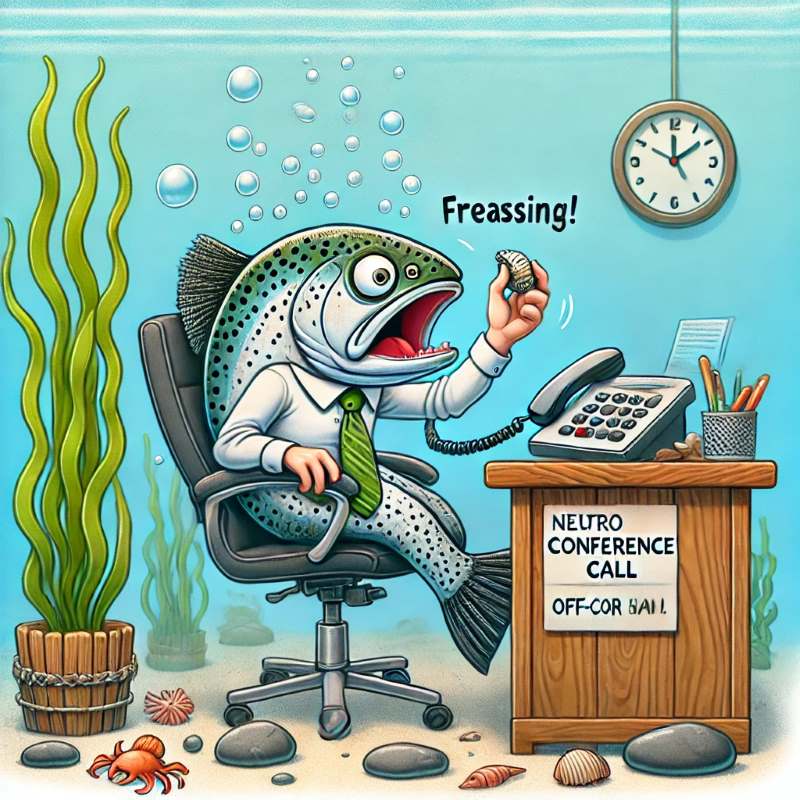
    The trout, aptly named “Terry Trout,” was hanging onto the conference call by a fin, doing its best to look calm in the video box. But off-camera? Total meltdown mode.

    As soon as Terry muted his mic, he began darting nervously around his underwater office, spiraling in tight circles. He grabbed his favorite shell, a grounding tool he’d use when the stress bubbled up, and fidgeted with it, running it back and forth between his fins. “Oh, gills, oh gills,” Terry muttered to himself, trying to take slow breaths through his scales. Every time the eagle barked out another deadline, Terry’s stress level spiked, and he accidentally knocked over his favorite kelp plant.

    Finally, he took a deep breath and muttered, “You got this, Terry. You got this.” Then, he carefully swam back into his video box, forced a calm nod for the boss, and tried to keep his tail from twitching.

    Step 1: Ask for Processing Time
    The project list hit me like an inbox on a Monday. Instead of freezing, though, I managed to gather my wits and say, “I’ll need some time to process all of this before I can respond.” Yes, I’m aware it sounds like a buttoned-up version of “gimme a minute,” but hey, it worked. My boss nodded, possibly mistaking my overwhelmed expression for enthusiasm. Victory: I’d stalled. And sometimes, stalling is half the battle.

    Step 2: Ask for Clarity
    Once I had my bearings, I realized… wait, what exactly are these projects? Were they real tasks, or just abstract, existential threats? The line was fuzzy. So, I asked for some good old-fashioned clarification. “Could we break down what’s expected for each task, along with realistic deadlines?” I asked, faking the calmness of someone who totally had it together. (Internally, though? Full-blown Homer Simpson-backward-into-the-bushes mode.) Miraculously, I got answers that weren’t just “ASAP,” which, as we all know, translates to “yesterday.”

    Step 3: Non-Verbal SOS
    Then came the point where words were just not gonna cut it. I switched to non-verbal cues, the millennial equivalent of waving a distress flag. I scribbled “FEELING OVERWHELMED” on my notepad and placed it strategically within my boss’s line of sight. It worked, at least a little, and I didn’t even have to actually say, “HELP!” Small wins are still wins.

    Step 4: Discreet Stimming
    Throughout all this, my leg was bouncing like I was auditioning to be a jackhammer. Apparently, stimming doesn’t have to be obvious; tap-tap-tap went my foot in a subtle rhythm of survival. I even had a pen spinning in my fingers like a mini fidget spinner to keep from visibly unraveling. (Pro tip: always have something to fiddle with at work, it’s better than losing your mind.)

    Step 5: The Strategic Escape
    When the pressure cooker vibe hit its peak, I remembered: oh yeah, I can step out. So, I politely excused myself to “grab some water,” which was really code for deep breathing and staring at the vending machine like it held the secrets of the universe. I returned a few minutes later, marginally less frazzled. If my brain was scrambled before, now it was more like sunny-side up. A minor improvement, but I’ll take it.

    Step 6: Advocating for the Future
    Post-meeting, after inhaling a snack as though my life depended on it, I did a little proactive advocacy. I asked my boss if, going forward, we could get a heads-up with bullet points of new projects before the meetings. She actually agreed, and that felt like a solid step forward for both my sanity and for making the workplace a friendlier space for anyone who’s wired like I am.

    And that, folks, is how I survived a professional version of “Sink or Swim” without jumping ship. The moral? It’s not always about acing the meeting itself; it’s about finding all the little strategies that keep you afloat—preferably before you run out of candy bars. Stay overwhelmed, but stay adaptable, my friends.

  • Asperger’s May Not Be Correct

    Asperger’s May Not Be Correct

    The term “Asperger’s syndrome” is no longer used in formal diagnoses. The DSM-5, the standard manual for mental health diagnoses, now categorizes Asperger’s under the broader umbrella of Autism Spectrum Disorder (ASD). Autism presents a wide range of characteristics and histories.

    Traditional Differences Between Asperger’s and Autism

    Historically, Asperger’s syndrome was differentiated from other forms of autism based on language development and cognitive ability. People with Asperger’s were often described as having average or above-average intelligence and no significant language delays, though they might have struggled with social interactions and nonverbal cues. Today, these differences are understood as part of the broader autism spectrum, recognizing that each individual’s experience with autism is unique.

    The Complicated Legacy of Hans Asperger

    Hans Asperger, the Austrian doctor who first described the traits we now associate with Asperger’s syndrome, has a legacy that is complex and controversial.

    • Ties to Nazi Ideology: Research has uncovered Asperger’s connection to Nazi eugenics programs. He referred children to Am Spiegelgrund, a clinic notorious for its horrifying treatment of disabled children, where many were subjected to euthanasia. This clinic became a place of suffering and loss for hundreds.
    • A Shift in Views: Initially, Asperger’s descriptions of autistic traits were rather neutral, but as Nazi influence grew, his language shifted as well. Terms like “abnormal” and “psychopathic” began to surface in his work, raising questions about his motivations and the impact of the political climate on his views.
    • Rethinking History: Historians like Edith Sheffer have shed light on how Asperger’s work aligned with eugenics ideology, prompting a reassessment of his role. Some see him as having protected autistic children from Nazi persecution, while others criticize his categorizing approach and his complicity with the regime.

    Moving Forward

    Today, “Asperger’s syndrome” is a loaded term, especially given the dark history behind its name. This realization has fueled calls within the autism community to rethink the language we use when talking about autism spectrum disorders. The DSM-5 has already made changes, categorizing Asperger’s under Autism Spectrum Disorder to reflect a more inclusive understanding of autism.

    Shouldn’t this neurodifference be defined by the people who are neurodivergent? We may not all speak the same language, but can’t we agree to define these terms ourselves? Not by the mental health or medical industries—at the very least, let’s remove the word ‘syndrome.’ After all, it’s a spectrum!

    Citations

    [1] https://www.thetransmitter.org/spectrum/new-evidence-ties-hans-asperger-nazi-eugenics-program/

    [2] https://en.wikipedia.org/wiki/Hans_Asperger

    [3] https://dsq-sds.org/index.php/dsq/article/view/7862/5906

    [4] https://www.bps.org.uk/psychologist/aftermath-hans-asperger-expose

    [5] https://www.theguardian.com/world/2018/apr/19/hans-asperger-aided-and-supported-nazi-programme-study-says

  • Montana Misunderstanding

    Montana Misunderstanding

    Maggie & Marvin’s Tale

    Maggie, a sharp-tongued Black-billed Magpie, and Marvin, a laid-back Yellow-bellied Marmot, made for an unexpected duo. You know how they say opposites attract? Well, this pair was living proof. Maggie, diagnosed with autism later in life, had a knack for turning nests into works of art—think Frank Lloyd Wright but with twigs. Marvin, ever the chill marmot, admired her eye for detail, though he sometimes found himself tangled in her meticulous ways.

    Of course, love doesn’t come without its hiccups. Marvin, a big fan of casual compliments, would say things like, “Wow, you’ve really outdone yourself this time!” about her nests. Maggie, ever the literalist, would spiral: “Outdone myself? How do I even do that?” Then there were Marvin’s spontaneous visits to her favorite foraging spots. He thought they were sweet little surprises; Maggie? She saw them as chaotic intrusions into her perfectly orchestrated day.

    It wasn’t long before these little misunderstandings started to pile up. Marvin felt sidelined, like he just couldn’t do anything right. Maggie, on the other hand, felt frazzled, struggling to articulate why something as simple as a surprise visit could throw her off balance. Eventually, they both needed space, Marvin retreating to his burrow and Maggie retreating into, well, Maggie-land.

    But love, in its weird and wonderful way, tends to have a gravitational pull. No matter how far apart they drifted, they realized they cared too much to let go. Marvin made the effort to understand Maggie’s perspective, swapping his cryptic compliments for more straightforward praise.

    Was their path forward going to be easy? Heck no. Because maybe love isn’t just about cozying up in the same space, it’s about figuring out how to speak each other’s language.

  • Why boneshakerbike?

    Why boneshakerbike?

    Okay, so here’s the thing. Labels and expectations, they never really sat right with me. It’s like everyone’s on this paved highway, cruising along, and I’m stuck on this new but rugged “Boneshakerbike”—a bike built by my friend Andrew Wellman, who worked at the Burton Snowboard Factory and built bicycles at night, trained by Ted Wozak. I’m rattling and shaking, struggling to keep up. But, and this is important, I still get where I need to go.

    See, success, for most people, it’s all about these shiny milestones – degrees, money, the whole nine yards. But those things, they never really clicked for me. My brain, it just works differently. It’s like I’m wired for a different kind of journey.

    One day, I was hanging out with my friends, Paul and Lucy, at this cozy little cafe, totally venting about how life just felt… off. The neurotypicals thought I was asking their opinion, so they started filling me up with bullshit talk about how college is the answer and… well, that isn’t the point of this blog, and I am still mad at them. Left alone, I would have become the world’s best influencer with the most YouTube followers. Back to this story. To be official, Paul told me I needed this thing called a Hotmail account. Email. And I needed to come up with my new name that would follow me around my entire life. We were talking about email addresses, of all things, and he said, “Make it something that’s really you.” And that’s when it hit me.

    Boneshakerbike

    It was perfect. It captured this feeling of being rough around the edges, maybe a little clunky, but unstoppable. Just like that bike, I might be jarring, I might make a lot of noise, but I get to my destination eventually.

    It’s not about being the fastest or the smoothest. It’s about resilience, about embracing the bumps and detours. It’s about owning my unique journey, neurodivergence and all.

    So, yeah, Boneshakerbike. It’s my email, my website, my online persona. It’s a reminder to myself, and maybe to others, that it’s okay to be different. It’s okay to travel a different path. Because sometimes, the most rewarding journeys are the ones that take you off the beaten track.

    Looking Back

    So on this day in history I am looking at the posts and one really stands out given what I know now. One post that bleeds autism is: Trust

  • Divergent Resources

    Divergent Resources

    My

    I wanted to take a minute to share some of the YouTube channels I’ve found especially helpful. Why YouTube? Well, because I relate best through stories and experiences. These channels, all hosted by autistic creators, each offer something unique and bring different perspectives on what it’s like to be autistic. My favorites are at the top of the list!

    • Chris and Debby have a channel I keep coming back to. Chris, diagnosed later in life, and his partner Debby, talk openly about the ups and downs of autism in adulthood. Their candidness is refreshing, like a breath of fresh air after you’ve been holding it all day.
    • Divergent Conversations are two of us, but therapists, who can help explain what I directly relate to that the outside does not. YouTube! See also https://neurodivergentinsights.com/ … and now that I want to move to SubStack: https://neurodivergentinsights.substack.com
    • Neurodivergent Doctor is another gem. Dr. Service tackles both autism and ADHD, digging into topics like diagnosis and self-diagnosis with a nice mix of expertise and empathy. It’s like getting advice from a friend who’s also just… smarter than you.
    • Jinjer isn’t divergent, but there’s something about Tati that I really relate to. Her energy, intensity, and the way she expresses herself just clicks with me on a deeper level. She’s mentioned being an introvert, and the way she communicates through her music resonates with my neurology in a way that feels oddly familiar and comforting.
    • Rob is and who broke my brain to start this journey.
    • Orion Kelly – That Autistic Guy is a bit of a treasure trove. Orion covers everything from navigating sensory overload to surviving in a world built for neurotypicals. His passion for advocacy shines through every video, and honestly, it’s contagious.
    • Mom on the Spectrum is a go-to for parents navigating autism. Taylor, a late-diagnosed autistic mom of two autistic kids, provides down-to-earth advice while promoting awareness and acceptance. Her videos are like that solid chat with a friend who just gets it.
    • Woodshed Theory I recently found Claire’s channel, Woodshed Theory, and it’s such a gem! Her quirky, unfiltered videos combine fun DIY projects with real talk about her life as an adult autist. Plus, she has bunnies! It’s a perfect mix of creativity and charm, and I’d definitely recommend checking her out.
    • Proudly Autistic is perfect if you’re newly diagnosed or still figuring things out. The host talks about the tricky stuff like misdiagnosis and self-advocacy, making it feel like you’re not so alone in the process.
    • AdultwithAutism is one you shouldn’t miss. Paul shares his own story of being diagnosed later in life, and his openness about the journey of self-acceptance is both inspiring and, at times, pretty moving. Grab some tissues just in case.
    • Thomas Henley hosts Thoughty Auti – The Autism Podcast where he chats with other autistic folks and experts. If you’ve ever wondered about the connection between autism and addiction, or just want to hear thoughtful conversations on neurodivergence, this one’s for you.
    • Elena Carroll talks candidly about her late diagnosis too, focusing on things like masking and handling those tricky emotional moments. Her channel feels like a guidebook for how to exist authentically, without the constant stress of trying to fit in.
    • I’m Autistic, Now What? dives deep into monotropism—an autism theory worth checking out if you’re curious about how the autistic brain processes the world. It’s like a mini course on why our minds work the way they do.
    • NeurodiverJENNt She’s an AuDHD content creator who discovered her diagnosis after her son was diagnosed with Autism. Like many women, she had masked her symptoms for years and didn’t realize how misunderstood Autism and ADHD can be, especially in women. Now, she shares her journey to help others see what neurodiversity truly looks like.
    • Dave’s Garage Dave, the creator of “Dave’s Garage,” is autistic and aims to clarify the difference between autism and psychopathy. Using Dr. Robert Hare’s psychopathy checklist, he highlights key differences: while both may involve emotional challenges, autism is about social communication and sensory issues, whereas psychopathy includes a lack of empathy and manipulative behavior. He notes that while it’s possible for someone to be both autistic and a psychopath, it’s rare, as the traits generally conflict.

    These are just a handful of the many fantastic YouTube channels out there led by autistic people. Each one offers something a little different, so go ahead and dive in—there’s so much to learn from this incredible community!

  • Oh, THAT’S Why I Did That

    Oh, THAT’S Why I Did That

    Time Travel Through October 18ths

    Reflecting on October 18th across various years, it’s wild to see both the changes and constants in my life. These snapshots help piece together my evolution, showing what has shaped who I am today.

    Early Career Focus and Social Life:

    • In 2004, I was preparing to launch a website for prospective employers, displaying my classic monotropic focus. Even then, there was a pull toward the outdoors, I remember noticing the winter snow in the mountains and planning to get into biking once the website was done.
    • In 2005, I struggled with work-life balance, facing workplace conflicts and time clock issues that threatened a raise. I tried organizing “Friends and Family” events to stay connected, but when attendance dropped, I let them go. It highlighted my desire for social connections and the challenges of maintaining them as an autistic individual.

    Passion for Mountain Biking and the Outdoors:

    • By 2007-2008, mountain biking had cemented itself as my special interest. I was also expanding my outdoor activities, hiking Jumbo Saddle and helping friends with everyday tasks like “cat litter duty.”
    • In 2012, I completed the RMVQ in 4 days, 8 hours, and 47 minutes—showcasing my deep immersion in the sport.
    • By 2018, I was exploring the Crazy Mountains, discovering “zen-like” trails that reminded me of Star Wars scenes. My unique way of experiencing nature reflected the perspective many neurodivergent individuals bring to their adventures.

    Health-Conscious Lifestyle:

    • In 2013, I shifted towards a health-conscious lifestyle. My neurodivergent trait of information seeking led me to extensively research the “primal” lifestyle, collecting resources from experts. I wasn’t just passively consuming information—I challenged others to engage with these ideas too.

    Content and Relationship Evolution:

    • From 2020 to 2022, my content evolved from writing to vlogging, capturing adventures like Yellowstone and the Three Larch Trail with Mo. The “green goggle night” experience marked a significant point in our relationship.
    • Collaborating with Mo (“MoBill”) represented growth in how I approached relationships and content creation, showing a deepening connection over time.

    A Key Discovery:

    • Watching Rob Warner on a podcast led me to discover neurodivergence. His experiences made me reflect on my own patterns, helping me realize that what I thought was just “me” was part of something larger, something shared that explained so much of my life. This was when I began to truly understand and embrace my neurodivergent identity.

    This journey highlights how my interests, relationships, and self-understanding have evolved while certain core aspects have remained. Each October 18th adds another piece to the puzzle of who I am. Today, I don’t know, burnout and the possibility of going camping is all I got.

  • The Story

    The Story

    About Me

    Hey, I’m Bill Martin. I’m usually out on the trails or, well, hitting the jumplion 🙂 Due to my recent discovery of who I truly am, I realized I need to come up with a different ‘About Me’ page. I’ve stopped pretending to fit in, and life is a lot more interesting that way.

    A “Normal” Start

    I grew up in Roundup, Montana, where cattle outnumber people and the Bull Mountains (really just hills) shaped my childhood. I ran cross-country, hated school, and tried to fit the neurotypical mold. I became a competative mountain bike racer then I got a degree and landed a coding job at Sikorsky Aircraft, working on the Comanche Helicopter Project. But I was always daydreaming about the mountains.

    The Mountains Called

    After three years in Connecticut, I headed back to Montana—Missoula this time. I kept coding at MARS Stout Inc., but now I had the trails to balance out life. TNR (Thursday Night Ride) became my tribe—a crew of friends who mixed tough rides with good times.

    It all started in 2010 at an Adventure Cycling holiday party, with a bit of Michael Jackson dance inspiration. Team MoBill was born—a journey of rides, adventures, and finding love with Mo. From grueling climbs to unforgettable moments, we forged a partnership built on resilience and joy.

    2024: Divergent Awakening

    A friend once told me I was different and suggested I read Jonathan Livingston Seagull. I read it, and I understood.

    This year, I dropped the mask for good. I’m neurodivergent, and The Divergent Mountain Biker is more than a nickname—it’s who I am.

    If you’re looking for my resume, it’s around here somewhere. But wouldn’t it be more fun to talk trails or tech instead? Welcome to my journey.

    Explore More

  • Insights From a Podcast

    Insights From a Podcast

    I recently listened to a podcast featuring Paul and Claire, two autistic individuals, and honestly, it was like finding my people. You can check it out here: https://youtu.be/N3vM_tidi2g?si=DAhtqBB_KF6j_rdJ—but only if you promise to come back!

    Embracing Individuality

    Paul and Claire talked about embracing autism as a positive part of themselves. Now, I’m trying to do the same. It’s not easy; sometimes it feels like trying to find Wi-Fi in a concrete bunker. But hey, if Paul and Claire can do it, I might as well give it a shot. Lonely or not, I’m working on embracing my quirks, even if the rest of the world thinks I’m the Wi-Fi.

    Managing Energy

    Paul and Claire are all about managing energy, avoiding overwhelm, and making time to recharge. Basically, they’ve mastered the art of adult naptime. And who doesn’t love a good nap? Personally, I’ve been trying this approach—it’s like hitting “pause” on the world until I’m ready to deal with it again. Way better than in-person small talk, and it kind of works.

    Masking and Authenticity

    Ah, masking—the art of being a social chameleon, minus the cool ability to change colors. It’s exhausting, like trying to run a marathon in dress shoes. Hearing Claire talk about letting go of masking was like someone handing me a comfy pair of slippers. Finally, someone gets it! It’s all about acceptance: if we could just be our awkward, stimming, totally wonderful selves without pressure, life would be like… pajama day, every day.

    Control and Communication

    Paul’s need for control and predictability totally makes sense to me. Who doesn’t want to know what’s coming? Life is hard enough without surprises (unless they involve cake). Honest communication is another big one—pretending to be polite in uncomfortable situations feels like being stuck in customer service forever: “Sure, let me just smile while everything inside me is screaming.” No thanks, I prefer the truth, even if it’s a bit blunt. Also, having predictable routines, like a daily ride on my mountain bike, brings me some much-needed stability.

    Redefining Success

    Claire’s take on redefining success really hit home. Forget climbing some societal ladder—I’d rather redefine success as making it through the grocery store without losing my sanity or finding the perfect pair of sensory-friendly pajamas. Traditional success metrics don’t fit everyone, and that’s okay. Let’s set our own standards, even if that just means surviving Monday.

    Conclusion

    Listening to Paul and Claire felt like discovering a secret handshake for people like me. Their insights were validating, inspiring, and honestly, a bit like someone finally reading the instruction manual I never got. By sharing our experiences, understanding masking, sensory overload, and self-advocacy, we can help each other live more authentically—like comfy pajama-day, honest-to-goodness, Wi-Fi-connected authenticity.

    For more insights from Paul and Claire, and for your own secret handshake moment, check out the full podcast: https://youtu.be/N3vM_tidi2g?si=DAhtqBB_KF6j_rdJ.

  • Organizational Turmoil at Work

    Organizational Turmoil at Work

    A Neurodivergent Perspective

    The transition involving the remote work agreement quickly became overwhelming. They framed it as “standard procedure,” but with the questionable connections among senior management, I could sense something was off. I didn’t fully understand all the implications, but the lack of clarity, mixed messages, and the pressure to comply made the entire situation deeply uncomfortable. I didn’t have much of a choice but to go along with it—changing plans suddenly or figuring out an alternative under so much pressure is always a challenge for me.

    The July 1st Meeting: A Turning Point

    On July 1st, we were called into a meeting, and I immediately felt my senses going into overdrive. Even through the screen, the brightness in the room seemed overwhelming, the murmur of people talking made it hard to focus, and then this executive, who looked like he stepped out of ‘The Big Lebowski,’ started talking. His words seemed rehearsed, like he was a politician, and I couldn’t shake the feeling that there was more happening beneath the surface. He announced that our division would be absorbed by University Information Technology (UIT), calling it a “shared service model.” Officially, it was just a change in where the money came from, but to me, it felt more like losing my footing. The sense of independence I had counted on to keep my work routine stable was suddenly gone, and that was incredibly unsettling.

    The Start of the Chaos

    Soon after, my computer started showing the UIT logo, which felt like an unwanted intrusion. I know it’s just a symbol, but seeing it constantly made everything feel foreign and unfamiliar, like my workspace was no longer mine. The constant presence of the logo was a form of visual discomfort that made it difficult for me to concentrate on my work. Our direct supervisor called an emergency meeting, and his nervousness was palpable, which only added to my own stress. There were no clear instructions—everything was vague, and the ambiguity made it almost impossible for me to plan or make sense of what was coming next. The chaos left me paralyzed, stuck in this loop of needing to act but not knowing where to begin. Autistic inertia took hold, and starting even simple tasks became incredibly hard.

    It became evident that the executive orchestrated this to gain control of our resources, probably to solve his own staffing issues. With our director—the only person who might have been able to fight back—out because of surgery, there was no real resistance. Our supervisor tried to stay optimistic, but I could see through it; his discomfort was almost contagious. At one point, he suggested I move to marketing. Me, in marketing? The idea was absurd. Programming is my area of expertise, and being pushed into an unfamiliar and unpredictable role like marketing felt almost painful. It’s like asking someone to abandon what makes them feel centered.

    Seeking Union Support

    The whole thing was getting too much, so I decided to reach out to someone in the union. Social interactions like this are difficult for me, but I had to do it. I prepared myself, rehearsing what I needed to say. She was direct and to the point, which I appreciated—it was easier for me to process. She told me that plenty of rules had been broken throughout this process, which made sense because everything felt so chaotic and wrong. Hearing her confirm that my discomfort had a basis in reality was a relief; it wasn’t just me misreading the situation.

    A Possible Solution

    Weeks passed, and the uncertainty only grew. Each day felt heavy, filled with mixed signals and constantly changing expectations. Then, a temporary supervisor stepped in, and she seemed alright. She communicated clearly and seemed supportive, which provided a momentary sense of stability, though I knew it could all change again. Despite this slight improvement, I couldn’t shake the feeling that this was still about manipulation and stripping away our autonomy. The executive behind all of this—well, I can’t let my guard down. His actions felt personal, almost like an attack on the predictability I rely on.

    Looking Ahead: Reflections and Next Steps

    Now that things are starting to settle and I have the opportunity to return to my original role at MSU, I can reflect on what’s been an incredibly challenging summer. It tested my resilience—professionally, yes—but also in terms of managing my sensory processing, my routines, and my ability to navigate social complexities that are inherently draining for me. The uncertainty and poorly communicated changes were very hard to manage and led to heightened anxiety and emotional exhaustion. The social dynamics were fraught with unspoken implications, which only added to the stress. I’m hopeful that with things getting back to a semblance of normalcy, I can recover from the burnout and emotional exhaustion. I want to reconnect with my work and maybe even regain some of the joy I used to feel when diving into my special interests. So, where were we?

    Understanding the Neurodivergent Experience

    The events described above capture many of the challenges that neurodivergent individuals, particularly autistic people, might face in a situation like this:

    • Sensory Overload and Discomfort: The bright computer screens and the persistent UIT logo were significant sources of sensory discomfort. Even though I was dialing in remotely, the constant presence of the logo on my screen created visual discomfort, making it increasingly difficult to focus and exacerbating my anxiety. Sensory processing differences mean that what might be a minor irritation for others can become a considerable barrier for autistic individuals.
    • Difficulty with Change and Uncertainty: The sudden absorption into UIT, combined with unclear instructions and shifting expectations, created an environment rife with uncertainty. For an autistic person, this kind of unpredictability is extremely challenging, leading to increased stress and difficulty in coping with the situation.
    • Social Challenges and Communication Difficulties: The unclear and manipulative communication from leadership made it difficult to understand the true nature of what was happening. The need to reach out to the union for support was a daunting task that required extensive preparation. Social interactions, especially those involving advocacy, can be particularly draining and anxiety-inducing for autistic people.
    • Impact on Routines and Special Interests: The disruption to the established work environment and the pressure to consider a role change to marketing threatened the stability of familiar routines and interfered with engaging in areas of special interest, like programming. This loss of control and routine can be deeply unsettling for autistic individuals.
    • Heightened Anxiety and Emotional Distress: The overwhelming uncertainty, sensory overload, and social pressures resulted in heightened anxiety, emotional exhaustion, and the feeling of being completely overwhelmed. These conditions are ripe for triggering meltdowns or shutdowns, which are not tantrums but rather intense responses to overwhelming situations.

    Overall, this entire scenario was a perfect storm for me: sensory overload, social challenges, disrupted routines, and persistent uncertainty. As a neurodivergent individual, this combination had a significant negative impact on my well-being, leading to burnout and a profound sense of instability.

  • Embracing Neurodiversity: Valuing Unique Communication Styles

    Embracing Neurodiversity: Valuing Unique Communication Styles

    Neurodiversity and Communication

    Neurodiversity refers to the natural variation in human neurological functioning, including differences in thinking, learning, and communicating. This concept recognizes that neurological differences, such as autism, are not disorders to be cured but rather natural variations to be respected and accommodated.

    Communication Styles

    Neurodivergent individuals, including those on the autism spectrum, often have unique and valid communication styles that differ from neurotypical norms. These differences should be recognized and valued rather than viewed as deficits:

    1. Direct Communication: Many autistic individuals prefer clear, direct communication without ambiguity or hidden meanings.
    2. Alternative Forms of Expression: Some may use non-verbal communication, written communication, or augmentative and alternative communication (AAC) devices.
    3. Info-dumping: Sharing detailed information about topics of interest is a valid form of interaction and connection for many neurodivergent people.
    4. Reduced Eye Contact: Avoiding eye contact does not indicate disinterest or dishonesty; it may be a way to process information more effectively.
    5. Stimming: Repetitive movements or sounds can be a form of self-expression or self-regulation.

    Societal Misconceptions and Biases

    It’s crucial to address societal biases and misconceptions about neurodivergent communication:

    1. Social Norms Bias: The expectation that everyone should conform to neurotypical social norms is harmful and exclusionary.
    2. Eye Contact Bias: Judging someone’s attentiveness or honesty based on eye contact is a neurotypical construct that doesn’t apply universally.
    3. Small Talk Bias: Difficulty with or disinterest in small talk doesn’t reflect poor social skills; it’s simply a different communication preference.
    4. Time Pressure Bias: Expecting immediate responses can disadvantage those who need more time to process information.

    Promoting Understanding and Inclusion

    To create a more inclusive society, it’s important to:

    1. Educate: Raise awareness about neurodiversity and different communication styles.
    2. Adapt: Neurotypical individuals should adapt their communication styles when interacting with neurodivergent people, rather than expecting conformity.
    3. Respect: Recognize that neurodivergent communication styles are equally valid and valuable.
    4. Ask: When unsure, ask individuals about their communication preferences.
    5. Challenge Stigma: Actively work to challenge societal stigma and misconceptions about neurodiversity.

    In conclusion, neurodivergent communication styles are not deficits to be corrected but valid forms of expression to be respected and accommodated. The onus is on society to broaden its understanding and acceptance of diverse communication styles, rather than expecting neurodivergent individuals to conform to neurotypical norms.

    Citations:
    [1] https://www.health.harvard.edu/blog/what-is-neurodiversity-202111232645
    [2] https://www.autisticslt.com/communicationfeatures
    [3] https://hbr.org/2022/10/stop-asking-neurodivergent-people-to-change-the-way-they-communicate
    [4] https://www.linkedin.com/pulse/neurodiversity-101-whats-your-neurodivergent-bias-prof-amanda-kirby
    [5] https://www.ncbi.nlm.nih.gov/pmc/articles/PMC8992913/
    [6] https://www.millennialtherapy.com/anxiety-therapy-blog/neurodivergence-and-social-norms
    [7] https://reframingautism.org.au/introduction-to-autism-part-5-neurodiversity-what-is-it-and-why-do-we-care/
    [8] https://www.frontiersin.org/journals/psychiatry/articles/10.3389/fpsyt.2023.1243618/full

  • My Unique Traits: Why I’m Different from Most People

    My Unique Traits: Why I’m Different from Most People

    This is my second post since rebranding the site to “The Divergent Mountain Biker.” I’ve gotta explain why I’m not your average person. This list took me two months. Knowing what sets me apart is key because it shapes how I see the world, whether I’m at work or just chilling at home. So, here’s a rundown of the quirks and traits that make me, well, me.

    1. Need for Solitude: I love my friends and family, but I need quality alone time to recharge and regulate myself. If I don’t, I burn out quickly from the energy it takes to process everything – conversations, events, feelings, and all. I identify with Jinjer here.
      Neurotypical people often gain energy from social interactions and may not need as much alone time to recharge.
    2. Dysregulated Sensitivity: I may experience hypersensitivity (over-experiencing) or hyposensitivity (under-experiencing) to things like light, touch, sound, smell, and taste, which often leads me to avoid certain environments. I can’t stand bright lights, water, fireworks, or gunshots. On the flip side, I love touching nature and pets. And corn? Yuck!
      Neurotypical people usually have a more balanced sensitivity to sensory inputs and may not be as affected by environmental factors.
    3. Unique Communication Styles: I communicate differently, often being labeled as quirky or different. I may ask many questions, interrupt frequently, and have a direct way of speaking.
      Neurotypical people often follow social norms more closely in communication and may find directness less comfortable.
    4. Special Interests and Inward Focus: I devote a lot of time and energy to specific interests like mountain bikes. These passions bring me joy and a sense of purpose, which can sometimes be seen as inward-focused. Past friends have often told me to “get over yourself.” Boo to you, jerks!
      Neurotypical people might have a wider range of interests and spend less intense focus on any single one.
    5. Masking and Camouflaging: From a young age, I developed strategies to fit in socially by suppressing my true self and pretending to be neurotypical.
      Neurotypical people do not usually need to hide their true selves to fit into social situations.
    6. Emotional Regulation Challenges: I may have intense emotional outbursts or seem emotionless, due to difficulties in identifying and processing emotions.
      Neurotypical people often have an easier time identifying, processing, and expressing their emotions.
    7. Difficulty with Change and Reliance on Routine: I struggle with changes to my daily routine, relying on strict schedules for comfort and to manage anxiety.
      Neurotypical people are generally more adaptable to changes in routine and less reliant on strict schedules.
    8. Literal Thinking: I take things very literally and logically, often struggling with abstract concepts and figurative language.
      Neurotypical people are usually more comfortable with abstract thinking and figurative language.
    9. Attention to Detail: I have a strong focus on small details and the minutiae of life, which can be beneficial in many situations.
      Neurotypical people might overlook small details and focus more on the bigger picture.
    10. Hyperfocus and Flow State: I can become intensely absorbed in activities or subjects, but sometimes neglect other responsibilities. So, what do you think I’m doing all the time? Mountain biking, of course! I mean, REALLY! If I’m not riding, I’m working on my bikes, watching YouTube videos, or playing with new technologies. Don’t get me started, lol.
      Neurotypical people might have a more balanced focus, able to switch attention more easily between tasks.
    11. Difficulty Reading Social Cues: I struggle with interpreting body language, facial expressions, and other non-verbal cues.
      Neurotypical people generally find it easier to read and respond to social cues.
    12. Monotone Voice: I don’t think I speak in a monotone voice, which might seem like I lack emotion or interest, but I do have a weird speech pattern. In my gut, I feel like I can’t use my voice to show emphasis or concern. It feels fake when I try to do that.
      Neurotypical people usually have more variation in their tone of voice, which can convey more emotion.
    13. Strong Sense of Fairness and Justice: I have a strong sense of right and wrong, fairness, and justice, which is why I hate politics for example.
      Neurotypical people might have a more flexible view of fairness and justice, influenced by social contexts.
    14. Clumsiness or Coordination Challenges: I often experience motor skill and coordination challenges, making me feel clumsy at times. I run into corners and stumble a lot when hiking. But on my bike? It’s like my gyroscope, keeping me balanced.
      Neurotypical people generally have better motor coordination and spatial awareness.
    15. Preference for Written Communication: I often prefer written communication for its clarity and the ability to process interactions at my own pace. I despise phones and people that wanna “talk”.
      Neurotypical people often find verbal communication more natural and may prefer it over written forms.
    16. Strong Memory and Knowledge Retention: I often have exceptional memories, especially about my passions and special interests. Not what you want me to remember.
      Neurotypical people may have a more balanced memory, remembering a broader range of topics.
    17. Difficulty with Abstract Concepts: I struggle with abstract thinking, preferring concrete, logical, and literal concepts.
      Neurotypical people are generally more comfortable with abstract and figurative thinking.
    18. Difficulty Initiating and Maintaining Conversations: I may struggle with the nuances of starting and maintaining conversations, often preferring direct and specific interactions. Small talk is STUPID!
      Neurotypical people usually find it easier to engage in and sustain casual conversations and small talk.
    19. Sensory Seeking Behavior: I engage in repetitive behaviors or movements to regulate and soothe myself, often seen as sensory seeking. Mom always wanted me to stop rocking or shaking my leg.
      Neurotypical people generally do not need to engage in repetitive behaviors for self-regulation.
    20. Directness and Honesty: I tend to speak my mind without a social filter, being direct and honest, which can sometimes be perceived as blunt or rude.
      Neurotypical people often use social filters and may be more indirect in their communication to avoid offending others.
    21. Difficulty with Hierarchies: I may not easily understand or recognize social and societal hierarchies, leading to misunderstandings. Societal hierarchies will set me off into a rage, then burnout.
      Neurotypical people typically have a better grasp of social hierarchies and norms.
    22. High Levels of Anxiety: I experience high levels of anxiety due to various factors like sensory overload, changes in routine, and social interactions.
      Neurotypical people usually experience less anxiety in similar situations.
    23. Exceptional Long-term Memory: I often have a remarkable long-term memory for facts and detailed information, especially related to my interests. I remember what tire you have on your bike but I don’t know your name or what I ate for breakfast.
      Neurotypical people may not have as strong a long-term memory for specific details.
    24. Strong Preference for Familiarity: I feel more comfortable in known environments and around familiar people, and can become distressed in unfamiliar situations.
      Neurotypical people are generally more comfortable with new experiences and environments.
    25. Sensitivity to Emotional Atmospheres: I can be highly sensitive to the emotions of others and emotional atmospheres, which can be overwhelming.
      Neurotypical people might not be as affected by the emotional states of others or the atmosphere.
    26. Strong Need for Predictability: I thrive in predictable environments and routines, which help maintain regulation and reduce anxiety.
      Neurotypical people are usually more adaptable to unpredictability and change.
    27. Intense Expertise in Interests: My intense interests can develop into significant expertise on specific topics or activities. Well, just mountain biking … lol.
      Neurotypical people might have a broader range of interests but may not develop the same level of expertise in a single area.
    28. Difficulty with Eye Contact: I may avoid eye contact, especially when disregulated, as it helps me process information better. I learned that eye contact is important but when I get stressed I fixate away from the eyes to try and figure things out.
      Neurotypical people generally find making eye contact more natural and important for social interaction.
    29. Literal Honesty: I often say things as I see them, being honest and factual, sometimes lacking tact.
      Neurotypical people might use more tact and subtlety in their communication to avoid hurting others’ feelings.
    30. Resistance to Being Touched: I may have hypersensitivity to touch, which leads to discomfort with certain types of clothing, hugs, or contact points. I like being touched by people I know, but I can’t stand how my clothes feel.
      Neurotypical people are generally more comfortable with physical touch and different textures.
    31. Hyperlexia: I may read but may not always understand the meaning behind the words. I was once told in school that I would, “never learn to read”. Thank you ChatGPT for explaining things.
      Neurotypical people usually develop reading skills and comprehension at a more typical pace.
    32. Strong Moral Compass: I have a pretty good sense of what is right and wrong, often guided by a strong internal belief. I don’t blindly follow laws designed to benefit the wealthy but instead weigh things based on their impact on others and nature
      Neurotypical people might have a more flexible moral perspective influenced by social contexts.
    33. Distinctive Learning Styles: I may have unique ways of learning, requiring more hands-on, visual aids, or repetition to grasp concepts.
      Neurotypical people often benefit from standard teaching methods and may not require specialized learning approaches.
    34. Difficulty with Small Talk: I struggle with the purposelessness of small talk, preferring substantive discussions. I have learned (masking) to ask the default questions like “how is your day”. But I ask it sometimes because I really care, not just to socially bond. F-that!
      Neurotypical people often engage in small talk as a social bonding activity and find it more natural.
    35. Strong Visual Memory: I have a strong visual memory, allowing me to recall detailed information about scenes, objects, and places. Bikes!
      Neurotypical people might rely less on visual memory and more on other types of memory.
    36. Tendency to Monologue: I can talk at length about topics I’m passionate about, often without realizing it. I also narrate while I go about my day, which drives Mo nuts.
      Neurotypical people usually engage in more reciprocal conversations and may not monologue as frequently.
    37. Difficulty with Implicit Rules and Social Norms: I struggle with understanding and following unwritten rules and social norms, which often leads to misunderstandings. Honestly, I don’t even know what half of this stuff is. I copied it from an autism paper.
      Neurotypical people generally grasp and follow implicit social rules more easily.
    38. Enhanced Pattern Recognition: I can recognize patterns in data, environments, and behavior at a higher level than my neurotypical peers. This is my SUPER POWER!
      Neurotypical people might not have as strong a focus on patterns and may overlook them.

    And there you have it – a comprehensive list of what makes me uniquely “me.” If you’ve made it this far, congratulations! You now know more about me than most of my friends do, though they’ve already got their own way of defining me. Why blend in when you can stand out? Happy trails!