Imagine this: you’re at a meeting, cradling your coffee, barely awake, trying to focus on the discussion. Then, out of nowhere, your boss says, “Hey, I need you to take on another project. Jamie’s swamped, so it’ll be a huge help if you can just add it to your list.” You blink, trying to process. And before you know it, he’s listing out tasks faster than you can count, like some kind of workplace infomercial host: “But wait, there’s more! Take this on now, and we’ll throw in an impossible deadline and a side of confusion, absolutely free!”
And that’s when my brain takes a vacation. I’m hit by a full wave of “wah-wah-wah” à la every adult in the Peanuts cartoons. Overload mode? Officially engaged.
Cue my spiraling internal monologue. Now we’re entering Dysregulation Town, population: yours truly. Somewhere in the back of my mind, a little voice is chanting, “Quit! Run! Escape!” But, naturally, I remember that storming out isn’t exactly a sustainable career move. So, I take a deep breath, mentally sift through those tips I read about handling these situations, and resolve to give a few a try. Spoiler alert: I didn’t quit. But it was a close call.
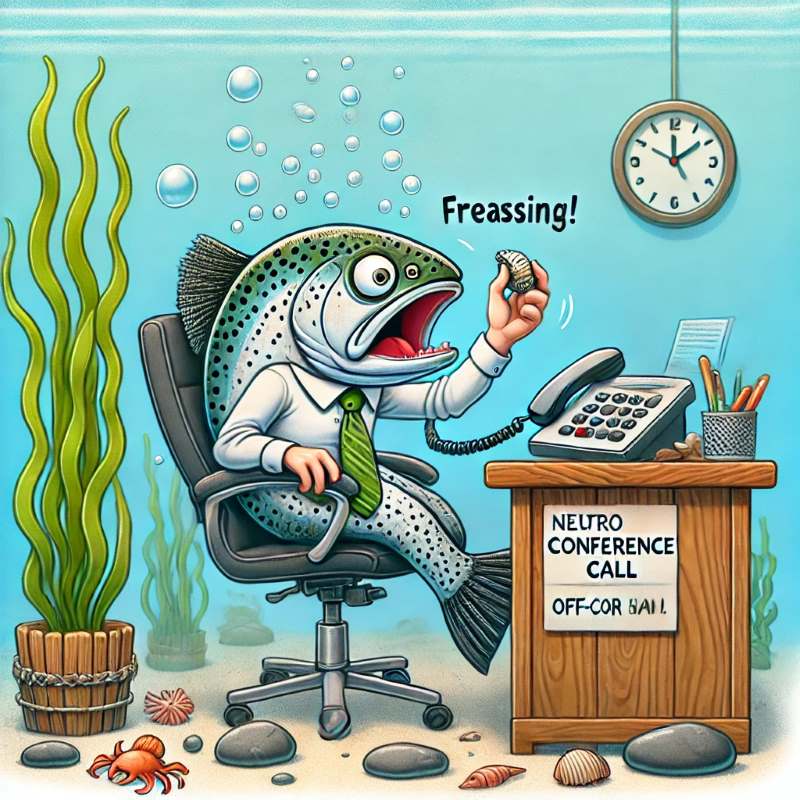
As soon as Terry muted his mic, he began darting nervously around his underwater office, spiraling in tight circles. He grabbed his favorite shell, a grounding tool he’d use when the stress bubbled up, and fidgeted with it, running it back and forth between his fins. “Oh, gills, oh gills,” Terry muttered to himself, trying to take slow breaths through his scales. Every time the eagle barked out another deadline, Terry’s stress level spiked, and he accidentally knocked over his favorite kelp plant.
Finally, he took a deep breath and muttered, “You got this, Terry. You got this.” Then, he carefully swam back into his video box, forced a calm nod for the boss, and tried to keep his tail from twitching.
Step 1: Ask for Processing Time
The project list hit me like an inbox on a Monday. Instead of freezing, though, I managed to gather my wits and say, “I’ll need some time to process all of this before I can respond.” Yes, I’m aware it sounds like a buttoned-up version of “gimme a minute,” but hey, it worked. My boss nodded, possibly mistaking my overwhelmed expression for enthusiasm. Victory: I’d stalled. And sometimes, stalling is half the battle.
Step 2: Ask for Clarity
Once I had my bearings, I realized… wait, what exactly are these projects? Were they real tasks, or just abstract, existential threats? The line was fuzzy. So, I asked for some good old-fashioned clarification. “Could we break down what’s expected for each task, along with realistic deadlines?” I asked, faking the calmness of someone who totally had it together. (Internally, though? Full-blown Homer Simpson-backward-into-the-bushes mode.) Miraculously, I got answers that weren’t just “ASAP,” which, as we all know, translates to “yesterday.”
Step 3: Non-Verbal SOS
Then came the point where words were just not gonna cut it. I switched to non-verbal cues, the millennial equivalent of waving a distress flag. I scribbled “FEELING OVERWHELMED” on my notepad and placed it strategically within my boss’s line of sight. It worked, at least a little, and I didn’t even have to actually say, “HELP!” Small wins are still wins.
Step 4: Discreet Stimming
Throughout all this, my leg was bouncing like I was auditioning to be a jackhammer. Apparently, stimming doesn’t have to be obvious; tap-tap-tap went my foot in a subtle rhythm of survival. I even had a pen spinning in my fingers like a mini fidget spinner to keep from visibly unraveling. (Pro tip: always have something to fiddle with at work, it’s better than losing your mind.)
Step 5: The Strategic Escape
When the pressure cooker vibe hit its peak, I remembered: oh yeah, I can step out. So, I politely excused myself to “grab some water,” which was really code for deep breathing and staring at the vending machine like it held the secrets of the universe. I returned a few minutes later, marginally less frazzled. If my brain was scrambled before, now it was more like sunny-side up. A minor improvement, but I’ll take it.
Step 6: Advocating for the Future
Post-meeting, after inhaling a snack as though my life depended on it, I did a little proactive advocacy. I asked my boss if, going forward, we could get a heads-up with bullet points of new projects before the meetings. She actually agreed, and that felt like a solid step forward for both my sanity and for making the workplace a friendlier space for anyone who’s wired like I am.

And that, folks, is how I survived a professional version of “Sink or Swim” without jumping ship. The moral? It’s not always about acing the meeting itself; it’s about finding all the little strategies that keep you afloat—preferably before you run out of candy bars. Stay overwhelmed, but stay adaptable, my friends.
 Boneshakerbike
Your Thoughts